
Darts, with standings
Darts league app for your crew
To run a darts league with friends, you need a board, one night a week, matches of best of 5 legs of 501 and a schedule that gives every player or team their matches, plus one place where everyone can see the scores and standings. A darts league app keeps that place, so nobody runs the season from a chalkboard.
Rival Nights is that app, made for your own crew rather than a pub league. You set up the season in a few minutes, everyone plays from their phone's browser, the other side confirms every result, and missed nights get new dates on their own. It's indoors, so the season runs all winter.
Your first league is free.
Not a pub league
Made for your basement.
Most darts league software is built for pubs and associations: an administrator, team sheets, fixtures at the venue. A league with your friends is different.
- No administrator. One of you is the commissioner, and the app does the admin: the schedule, the reminders and the make-ups.
- Your board, your night. Play in the basement, the garage or whoever's house has the board, on the night that works for you.
- Solo or doubles. A darts league starts one player a side; make it teams of up to 6 if your crew would rather play doubles.
- Everyone on their phones. Players open the invite from their email and sign in with a 6-digit code. Nothing to download, no password.
Darts scoring
Best of 5 legs. 501, double out.
Each leg, both sides start at 501 and count down, three darts a turn. Land exactly on zero with your last dart in a double to win the leg. Go under, or leave 1, and the turn busts. First to win 3 legs takes the match, with a 30-minute time cap.
How to play 501
Count down from 501 and land on a double to finish. The math is half the game.
What you need
- 3 darts each
- A standard dartboard
- Somewhere to keep score
Hang the board with the bullseye 5 feet 8 inches off the floor. Mark the throw line, the oche, 7 feet 9¼ inches from the face of the board.
How to play
- 1
Throw for the bull
Each team throws one dart; the closest to the bullseye throws first in the first leg. After that, legs alternate.
- 2
Three darts a turn
Throw three darts from behind the oche, add them up and take the total off your score. Both teams start every leg at 501.
- 3
Read the board
A dart scores its wedge's number. The thin outer ring doubles it, the thin middle ring triples it, and the bull is 25 outside and 50 in the middle.
- 4
Finish on a double
Your last dart has to hit a double that brings you to exactly zero. The bullseye counts as double 25.
- 5
Bust
Go below zero, leave yourself 1, or reach zero without a double, and the turn busts: your score goes back to what it was.
Scoring
Each leg is 501, counted down, and the first to zero on a double wins it. Best of 5 legs: win 3 to take the match.
Stand well back and stay quiet while someone's throwing.
Starter house rules
- Best of 5 legs of 501. Each leg, both teams start at 501 and count down.
- Three darts a turn, thrown from behind the line, 7 feet 9 1/4 inches from the board.
- Finish on a double to land exactly on zero. Go under, or leave 1, and the turn busts: back to where it started.
- Closest to the bull throws first in the first leg; after that the legs alternate.
- Keep score where both teams can see it.
- Bring your own darts if you have them.
Every new darts league starts with these. The commissioner can rewrite them, and they sit next to the schedule in the league's Rules tab.
Live scoring
Score it turn by turn.
Keep score at the oche on any phone. After each turn, type what the three darts scored. Rival Nights counts down what's left for each side, and the rest of the league can follow the score from the league's home screen.
- Hit zero? It asks whether the last dart was a double, so the checkout counts only when it should.
- Went under, or left 1? It calls the bust and the turn counts zero. It also catches scores three darts can't make.
- Typed the wrong number? Undo the last turn, or any line in the log.
- Save it and the final score becomes the result. The other side taps Looks right, or That's wrong.
A season, start to finish
Week 1 to finals night.
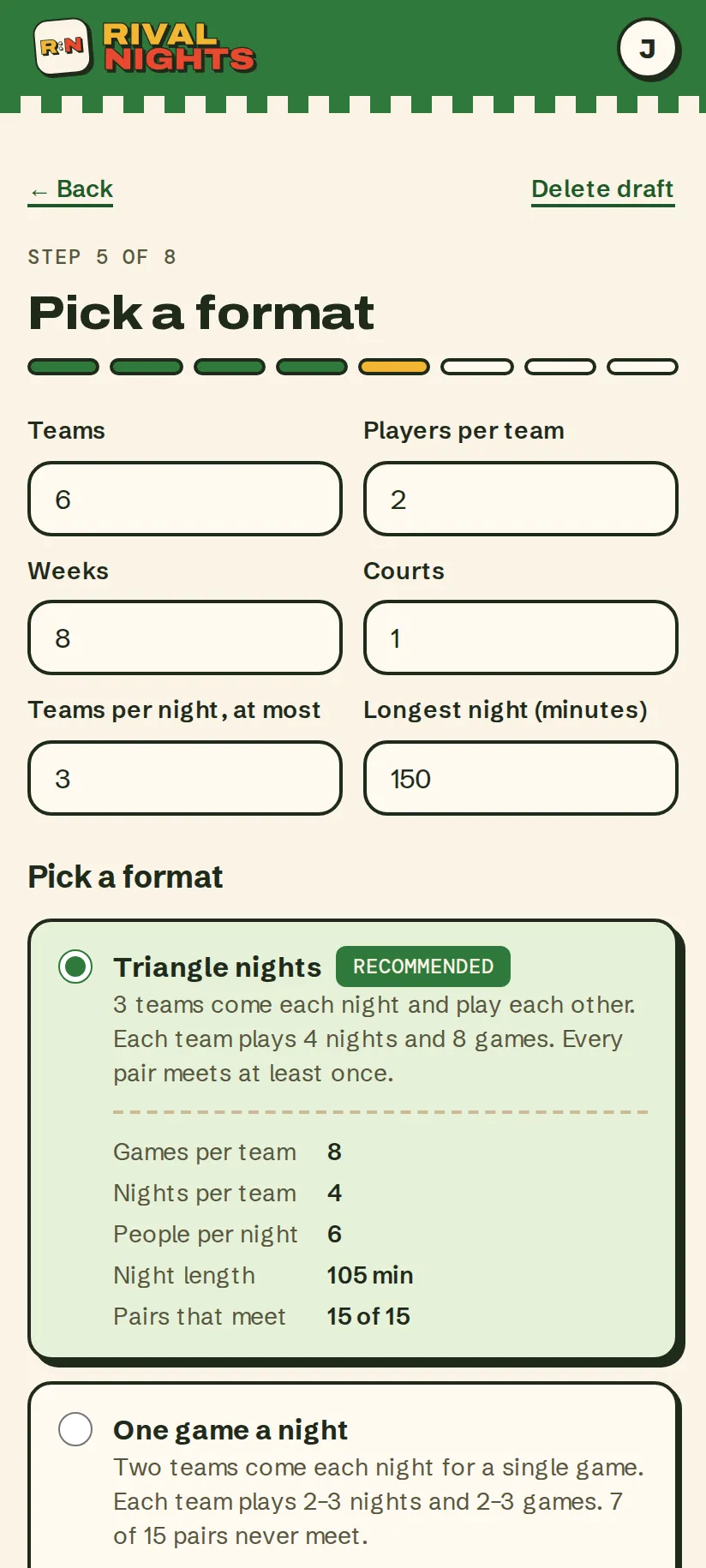
- Set it up. Pick darts, your night, how many weeks and how many boards. Rival Nights suggests schedule formats that fit, like Triangle nights: three come, and each plays two matches.
- Invite the crew. One player a side to start, or teams of up to 6. No email for someone? Add them by first name.
- Play the night. Everyone gets a reminder 3 days out and on the day. Can't make it? The match gets a make-up night proposed for both sides.
- Confirm the score. Either side enters the result, and the other confirms it, or it counts on its own after 24 hours.
- Watch the standings. Ranked by win %, then head-to-head, with who's clinched a playoff spot and who's out.
- Crown somebody. The top players or teams play a finals bracket, seeded from the standings.
See every screen of the demo league in the product tour, or read the FAQ. Something other than darts? Here's how a game night league works for any game, and our guide on how to start a league with your friends.
Board's up. Start the season.
Set it up tonight, send the invites, and your first league night is on everyone's calendar before anyone finds their darts.
Your first league is free. Then $3 a player per season, never more than $60, and on a season of up to 20 players your crew can split it.