
Guide
How to start a league with your friends
To start a league with your friends, pick one game and one night a week, split everyone into teams, and choose a format: a weekly season with playoffs, or a one-day tournament. Make a round-robin schedule so every team plays every other team, rank teams by win percentage with head-to-head as the first tiebreaker, and agree up front on make-ups, rain dates and forfeits. Then write the house rules down and send the schedule to everyone.
Here's how to do each step, with or without an app. At the end: a checklist, and how Rival Nights handles each step if you'd rather not run the league from a spreadsheet.
Your first league is free.
01Pick the game
Pick one game for the whole season, so every result counts the same. Good league games take 20 to 45 minutes, work with 1 to 4 people a side and don't need a referee: cornhole, bocce, darts, ping pong, pickleball or kubb. Card and board games work too, as long as two teams or two players face off.
Decide how a game is won before anyone plays: first to a score, best of a few games, lowest score wins, or just who won. That choice decides how you'll break ties later.
02Pick the night, and how often
Weekly works best: often enough to build a rivalry, rare enough that people show up. Pick one night and a start time, then count the weeks. Six to ten weeks fits between holidays, and skipping a holiday is easier before the schedule goes out than after.
Short on weeks? A one-day tournament gets the whole thing done in an afternoon.
03Decide on teams and players
Teams of two suit most lawn games; darts and ping pong often go one-on-one. Four to eight teams keeps a season easy to run, with enough opponents to stay interesting. Name a captain for each team, and agree whether subs are allowed.
Pick a commissioner, too: one person who makes the schedule, settles disputes and has the final say. Usually it's whoever suggested the league.
04Choose a format
A weekly season
Teams play a set number of games over the season, and the standings rank them. End with playoffs for the top teams (with 6 teams, the top 4 play semifinals and a final), or let first place take the title.
A one-day tournament
A knockout bracket in one day: lose and you're out. When the number of teams isn't 4, 8 or 16, the top seeds get a bye in the first round. Add a 3rd-place game so the semifinal losers play once more.
A bit of both
Open the season with a kickoff day for bragging rights, then end it with a finals day for the top teams.
05Make a schedule that's fair
Everyone plays everyone
A round robin pairs every team with every other team once. With an even number of teams, it takes one week fewer than you have teams: 6 teams play 5 weeks, one game each a night. Got more weeks? Start the cycle again.
Odd numbers and byes
With an odd number of teams, one team sits out each week, which is called a bye. The round robin then takes as many weeks as you have teams: 5 teams need 5 weeks, and each team sits out once.
Small groups and short nights
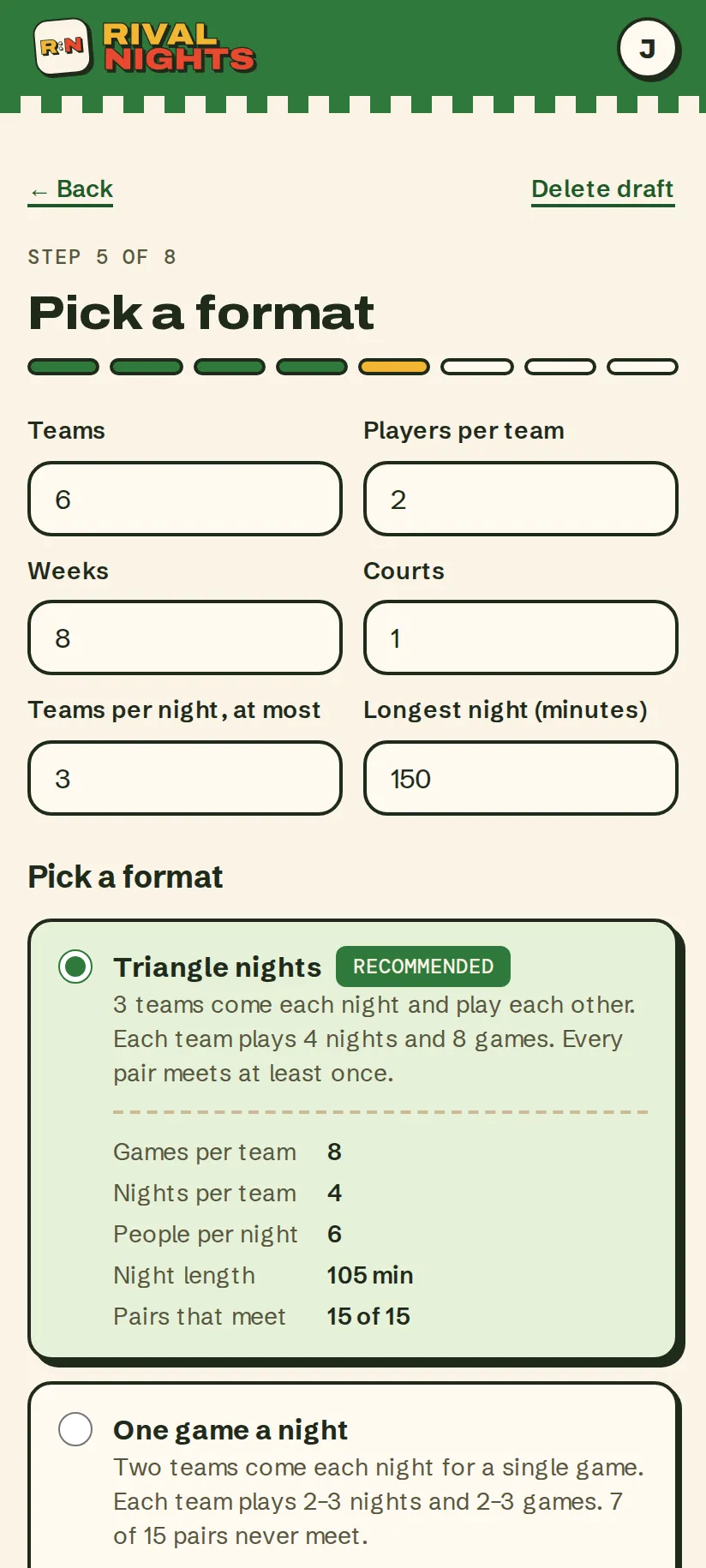
Not everyone can come every week? Try triangle nights: three teams come, and each plays the other two, so every team gets two games and the night stays short. If you have two sets of boards or two courts, play side by side and the night ends sooner.
06Settle scoring and tiebreakers
Rank teams by win percentage rather than total wins, so a team with a game still to make up isn't behind just for that. When teams are tied, go down this list:
- Head-to-head: the results between the tied teams, if they've all played each other.
- Point differential: points scored minus points allowed. In a game where the lowest score wins, lower is better.
- Still tied? Flip a coin before the playoffs, not after.
Agree on who records scores, too. The simplest rule: one team enters the score right after the game, the other team confirms it, and the commissioner settles any disagreement.
07Plan for nights someone can't make
Make-ups
Keep one extra night after the last week for games that got moved. When a team can't make it, propose a new night and give the other team a couple of days to object.
Rain dates
Playing outside? Hold a backup day a week after finals. If a whole night gets rained out, move its games to new nights rather than cancelling them.
Subs and forfeits
A team that's short a player can bring a sub instead of forfeiting, if your rules allow it. A game still unplayed after the make-up night is a forfeit for the team that couldn't make it. Score a forfeit as a win to the target, like 21–0 in cornhole, and decide how many forfeits keep a team out of the playoffs.
08Write down the house rules
Every crew plays a little differently. Before week 1, write down:
- How a game is won, and how long it can run
- Who goes first, and what happens when time's up
- The calls that start arguments, like a bag that bounces onto the board or a dart that falls out
- Who can sub, and who brings what
Put them where everyone can read them before the first game, not in a message from three weeks ago.
09Keep everyone in the loop
One place for the schedule, scores and standings beats a group chat everyone scrolls past. Send the full schedule before week 1, a reminder a few days before each night and another on the day, and post results the night they happen. Friends and family will want to follow along, too.
Before week 1
Checklist
Everything above, on one list. Tick it off and the league is ready to go.
- The game, and how a game is won
- One night a week, a start time and the number of weeks
- Holidays skipped before the schedule goes out
- The teams and their players, with a captain for each
- A commissioner with the final say
- The format: a weekly season with or without playoffs, or a one-day tournament
- A round-robin schedule, byes included
- Tiebreakers: win %, head-to-head, then point differential
- A make-up night, a rain date and a forfeit rule
- House rules, written down
- The schedule and rules sent to everyone
Doing it with Rival Nights
Each step, done for you.
Rival Nights is a web app for running leagues with friends. The commissioner sets up the season in 8 short steps, and everyone plays from their phone's browser. Here's what it does for each step above.
See it on real screens in the product tour, read the FAQ, or see how a game night league, a cornhole league, a bocce league and a darts league run on it.
1. Pick the game
Pick cornhole, pickleball, ping pong, darts, bocce or kubb, each with its own scoring, game length and starter house rules. For anything else, name it and pick how it's scored.
2. Pick the night
Pick the weekly night, the start date and how many weeks. Thanksgiving week and Christmas to New Year's come up as dates to skip, and you can add your own.
3. Teams and players
From 2 to 24 teams of 1 to 6 players. Invite them by email, add someone by first name only, or let the first teams to say yes take the spots.
4. The format
Kickoff, weekly play and finals; weekly play and finals; weekly play only; or a one-day tournament.
5. A fair schedule
Rival Nights builds schedule options for your teams and courts, shows how many pairs meet in each, and recommends one. Byes and Triangle nights included.
6. Scoring and tiebreakers
Either team enters the result and the other confirms it, or it counts on its own after 24 hours. Standings rank by win %, then head-to-head, then point differential.
7. Missed nights
A player taps “Can't make it?” to bring a sub, skip the week or forfeit. A skipped game gets a make-up night proposed automatically, and it stands unless a team objects within 48 hours. Games still unplayed at the make-up deadline become forfeits.
8. House rules
Your house rules sit in the league's Rules tab, next to the format, the tiebreakers and a how-to-play guide for the built-in games.
9. Keeping everyone in the loop
Email invites and reminders, a calendar subscription, a league feed, share cards for the group chat, and an optional read-only link for spectators.
Ready to start yours?
Rival Nights does the schedule, the scores and the make-ups for you. Set it up tonight and send the invites.
Your first league is free. Then $3 a player per season, never more than $60, and on a season of up to 20 players your crew can split it.